[The content of this article is provided by Ms. Sonam Dhingra. No one should copy and use these content without prior permission from Admin, www.mithilapaintings.com)
Kachni
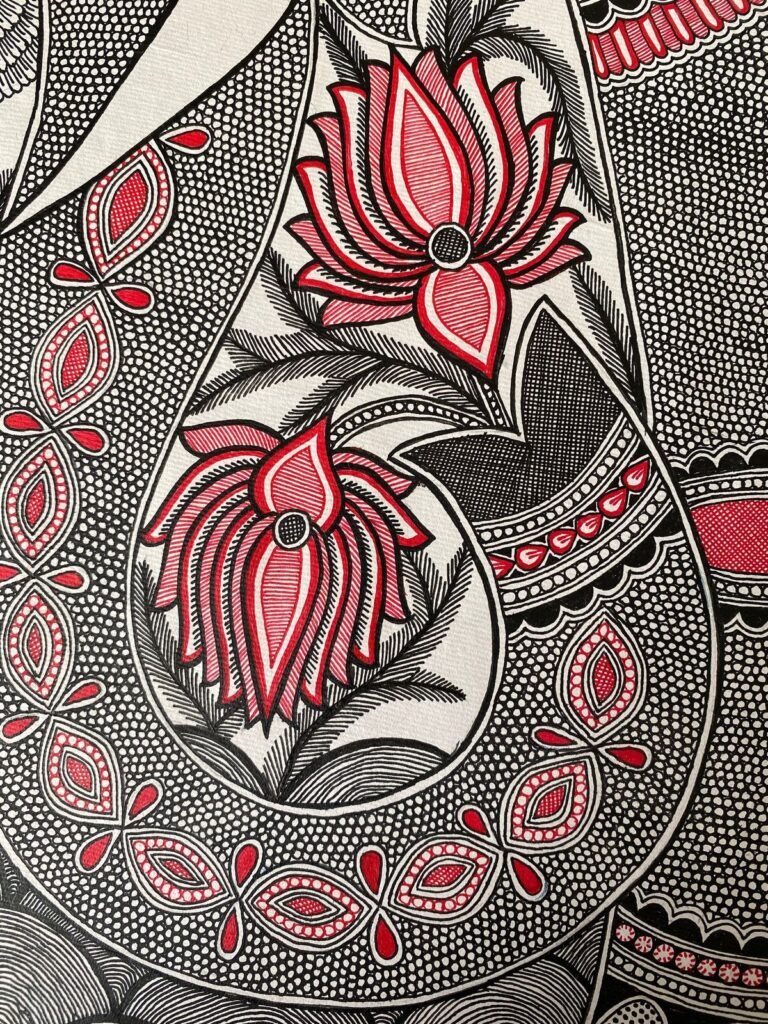
Kachni (or Katchni) is a traditional fine-line style of Madhubani Painting from Bihar, India, that relies on delicate monochrome or dual-tone line work instead of solid color fills. The word “kachni” means line drawingKachni means lines. In this style of painting only one or two colors are used. Fine pattern is made using hatching and stippling to create paintings with finest details. Double lines are used to depict the outlines.
Core Characteristics
- Line Work: Uses meticulous hatching, cross-hatching, parallel lines, and tiny dots to create texture and form.
- Color Palette: Usually monochromatic or limited to two contrasting tones like black and red or black and orange on a neutral background.
- Technique: Traditionally drawn using fine bamboo sticks or pens, emphasizing extreme precision and patience over bold painted blocks.
Common Themes
- Nature & Wildlife: Focuses heavily on animals, birds (like peacocks), fish, and floral motifs.
- Mythology: Depicts divine figures and religious symbols through intricate line patterns rather than vibrant fill colors
Bharni
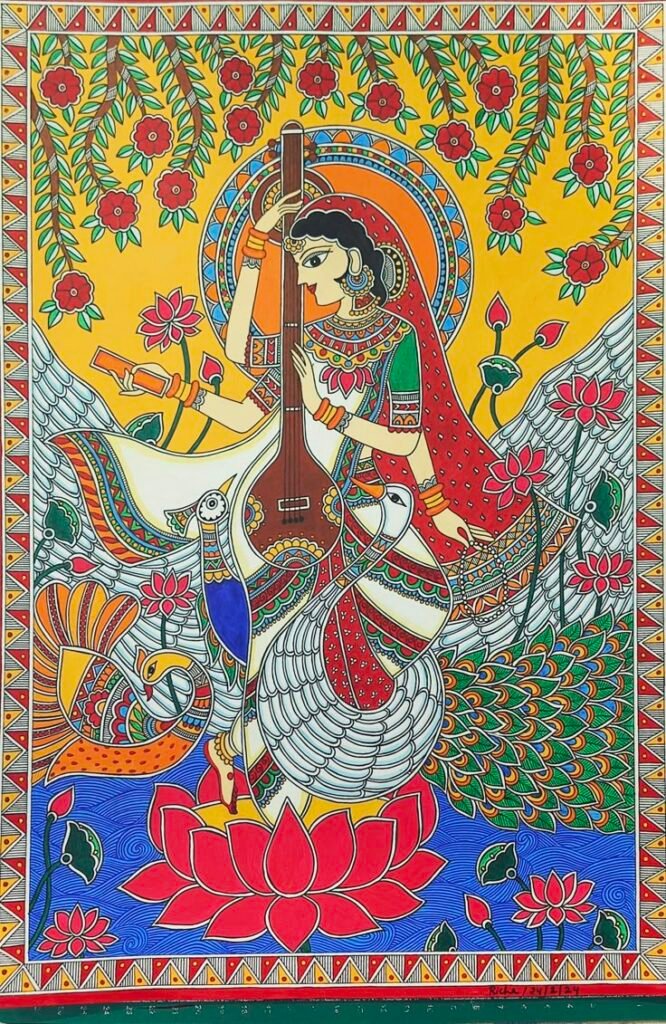
Bharni means filling. In this style the subject is outlined with black and the enclosed areas are filled with vibrant colors like blue, yellow, pink, green, orange etc.
Key Characteristics
- Vibrant Colors: Artists fill outlined spaces with bold, bright colors like red, yellow, blue, green, and orange.
- Bold Outlines: Figures and motifs are first drawn and heavily outlined in deep black ink or charcoal.
- Mythological Themes: This style traditionally depicts Hindu deities and epic narratives from the Ramayana and Mahabharata, featuring figures like Krishna, Rama, Sita, and Shiva.
Background and Techniques
- Origin: Traditionally practiced by upper-caste women in the Mithila region of Bihar, the style relies on stories passed down through generations.
- Natural Dyes: Authentic pieces use natural pigments and dyes extracted from plants, flowers, and soot, applied with twigs, fingers, or cotton brushes.
- Comparison: Unlike the monochromatic, fine-line etching of the Kachni style, Bharni focuses heavily on chromatic richness and solid color fills
Godna
These paintings were slightly less detailed and following a simple pattern than the famous Line Paintings (Kachni style) or Colour Paintings (Bharni Style) made by the Brahman and Kayastha groups.
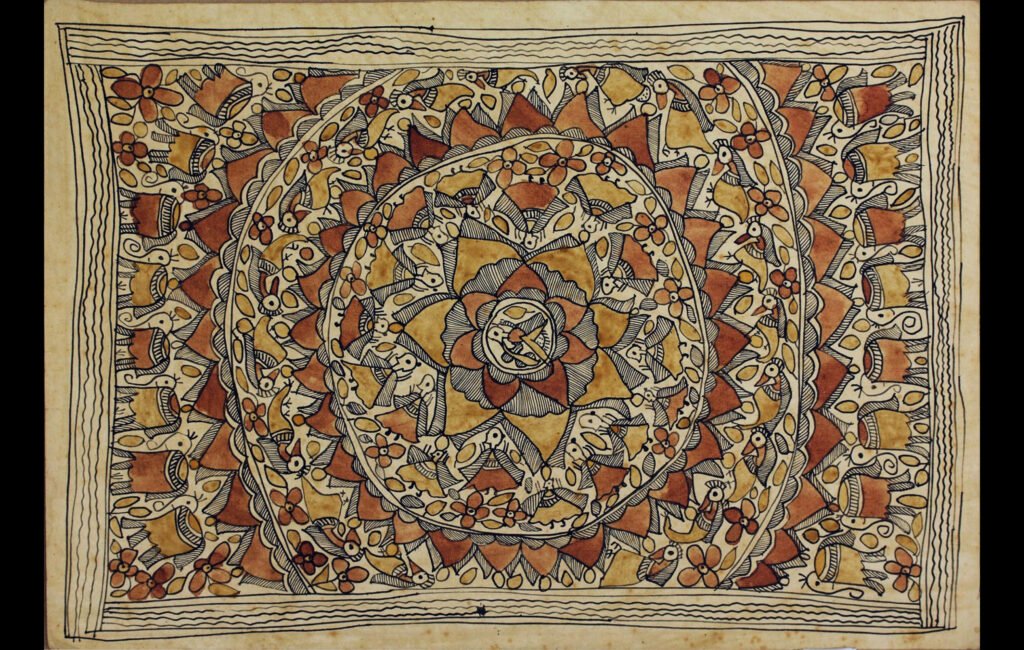
Godna paintings, like this one, look similar to Ariipana (floor) paintings but are different in motifs used, which is stylistically typical to the Dalit and the Dusadh community. Much like the upper caste tradition of Kachni and Bharni Mithila paintings, the Dalit and Dusadhs castes have, for decades, been decorating the walls of their homes for rituals. However, because of their lower caste status they were not allowed to showcase the divine in their artform. Thus, they found inspiration in geometric forms and flora-fauna surrounding the village. Among the many decorative styles from these castes was the Godna style, inspired from the Godna (tattoo) art practiced by the Nattin (Gypsy) women. Their visual language includes parallel lines and concentric circles containing floral motifs and the human form. More recently, local heroes are drawn in this style of painting, Raja Salhesh’s oral narratives and paintings, for example, are used as a symbol of resistance against upper-caste politics. He was a military man, who is now revered as a king, remembered for standing up against the discrimination of Dusadhs. Since 1972, even the Brahmin and Kayastha castes have appropriated the style.
This composition painted by an unknown artist perhaps depicts Raja Salhesh in the centre of concentric circles, the outer rings of which are detailed with motifs of women, animals and floral. The women may represent the wives of Raja Salhesh, the parrots were informants of the king, and the elephants were his vehicle. The colour scheme of the painting is sombre colours of yellow and orange, the borders of the paintings are drawn in simple lines.
Kohbar
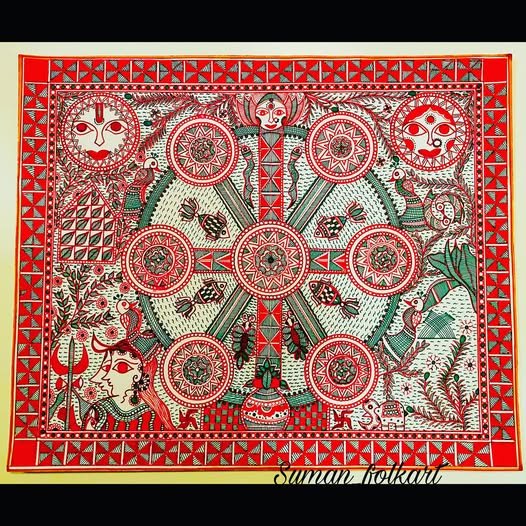
The Kohbar, painted on paper by a girl is sent by her to the boy of her choice as a marriage proposal; it is painted on the walls of bedroom to ensure fertility; on the paper used for wrapping gifts during courtship as a proof of a girl’s accomplishment in the traditional art and on the walls of the house for magic protection
This painting is made by Suman Sarma, ref: https://www.facebook.com/sumanfolkart/posts/sharing-one-of-the-most-famous-style-of-mithila-art-kohbar-%E0%A4%95%E0%A5%8B%E0%A4%B9%E0%A4%AC%E0%A4%B0-this-painting-o/146062484501771/
Tantrik
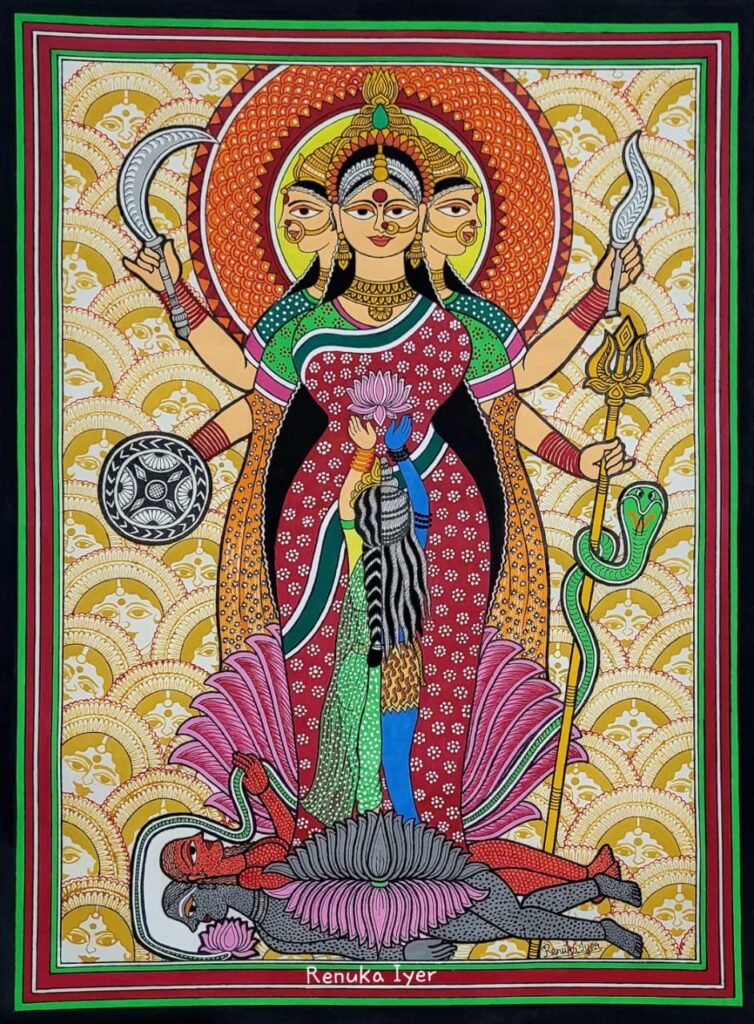
Madhubani Tantrik folk art is a sub-style of the traditional Mithila painting from Bihar, India, characterized by its depiction of religious and spiritual themes, incorporation of symbolic yantras (mystical diagrams), and intricate, often bold geometric line work. These paintings feature Hindu mythical figures, specific color codes, and symbolic imagery to represent divine energy and cosmic balance, often used in connection with rituals and spiritual practices.
Utilizes specific color codes and symbolic designs to convey spiritual concepts and represent divine energy and cosmic order.
Uses bright, often natural, colors sourced from plants and minerals to fill in the figures and patterns.
Deeply rooted in spiritual practices and rituals, reflecting Tantra’s influence on the art form. Historically created on walls and floors for significant religious ceremonies and festivals, but now also found on handmade paper, cloth, and canvas.
Aadhishakti in Madhubani tantrik folk art is a depiction of the primordial divine feminine energy, representing the ultimate source of all creation. This subject matter falls under the “Tantrik” style of Madhubani or Mithila painting, which focuses on religious and spiritual themes.